

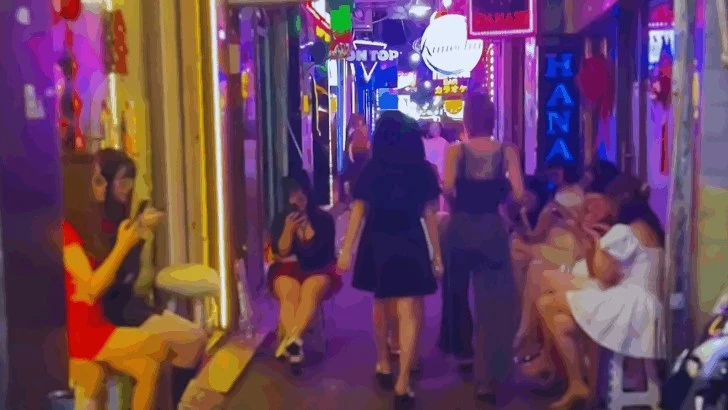
By day, it’s sushi, sake, and salarymen. By night, it transforms into a velvet-draped labyrinth of flirtation, fantasy, and flesh—Ho Chi Minh City’s best-kept secret: the unspoken red-light underworld of Japan Street.
Where Tokyo Meets Saigon: The Rise of “Japan Town”
Located in District 1, just steps from five-star hotels like the InterContinental and upscale malls like Vincom Center, Le Thanh Ton Street is the heartbeat of Saigon’s Japanese expat community. What started decades ago as a modest enclave for Japanese businessmen has now evolved into a miniature Tokyo, complete with izakayas, ramen joints, convenience stores stocked with Pocari Sweat, and quiet cafes playing J-pop ballads.
The nucleus of this community is Hem 15B Le Thanh Ton—a maze of narrow alleys behind closed metal gates, lit by dim orange lanterns and the occasional glowing Kirin beer sign. It’s atmospheric, elegant, and at first glance, innocuous.
But as the sun sets, a different pulse begins.
A Polished Exterior, A Hidden World
Where Bangkok’s red-light districts like Soi Cowboy, Nana Plaza, and Patpong operate in your face—pulsing neon, go-go cages, and hawkers on megaphones—Japan Street trades flash for finesse.
There are no dancing poles, no garish signs reading “SEX SHOW,” and no barkers shouting at tourists. Instead, the uninitiated might think they’ve wandered into a quiet dinner strip. But those who know… know.
-
A woman in a silk kimono outside a minimalist sake bar might ask if you’re “looking for company.”
-
A “massage spa” with bamboo décor offers no service menu—until you’re upstairs, behind a curtain.
-
“Hostess lounges” operate much like Japan’s kyabakura (キャバクラ) system, where patrons pay for conversation, companionship, and drinks. But the intimacy often extends far beyond karaoke duets.
The coded language of Japan Street is subtle, but consistent:
“VIP service.” “Private rooms.” “Special massage.” “Long-time or short-time?”
It’s the art of seduction draped in politeness.
The Hostess Economy: Japanese Structure, Vietnamese Execution
Most of the red-light operations here mimic the Japanese “hostess bar” model—clubs where beautiful women (often Vietnamese or Thai, some Japanese-speaking) pour drinks, engage in flirty small talk, sing karaoke, and provide companionship.
These women are known as “hostesses,” and their jobs involve much more emotional labor than outright sexual solicitation—at least on the surface. Patrons pay by the hour, by the drink, and often tip heavily to take the interaction further. Many of these hostesses also offer escort services, though this is never discussed openly inside the establishments.
Common practices include:
-
“Drink commissions”: Hostesses earn a cut of the drinks they persuade clients to buy for them—usually inflated in price.
-
“Time-based billing”: Bars charge by the hour, sometimes up to 1–2 million VND/hour (~$40–$80), just for company.
-
“After-hour negotiations”: If a client and hostess build rapport, the rest happens outside the venue. Hotels are just around the corner, or clients are invited to their apartments.
Most bars don’t directly handle money for sex—instead, they provide the environment for clients and workers to connect, leaving what happens next “off the books.”
Comparison: How Japan Street Differs from Bangkok’s Red-Light Districts
| Feature | Japan Street, HCMC | Soi Cowboy / Nana Plaza, Bangkok |
|---|---|---|
| Atmosphere | Discreet, polished, quiet | Loud, neon, chaotic |
| Clientele | Japanese businessmen, wealthy locals, expats | Tourists, backpackers, sex tourists |
| Venues | Hostess bars, karaoke lounges, hidden spas | Go-go bars, beer bars, open brothels |
| Workers | Vietnamese, Thai, sometimes Japanese | Primarily Thai women |
| Sex Work Visibility | Implied, negotiated privately | Open, commercialized |
| Pricing | High-end, subtle pricing | Competitive, clear pricing |
In short: Japan Street is what happens when a red-light district wears a suit and tie.
Inside the “Spas,” “Clubs,” and “Private Rooms”
There are three primary types of red-light venues in Japan Street:
1. Japanese-Style Hostess Bars
These are modeled after Tokyo’s elite Ginza clubs. You pay to talk, drink, and flirt. The women are trained in etiquette, small talk, and language—some speak Japanese fluently. It’s about emotional experience first, physical interaction second.
2. Massage Parlors with “Extras”
Labeled “wellness spas” or “body therapy,” these establishments offer private rooms and services that go beyond therapeutic. Some are Vietnamese-run, others Japanese-owned with foreign clientele in mind. Price range for full service: 2M–6M VND (~$80–$250) depending on the girl and package.
3. Escort Lounges and Discreet Bars
Often the most exclusive. You won’t find these on Google Maps. Entry is by referral or connection. The girls are high-end, often with curated social media profiles or messaging app listings (LINE, Zalo, Telegram). These bars function as high-class matchmaking venues for the night.
Legal Gray Zone: Why It Continues
Vietnam has strict laws against prostitution, with police raids happening periodically. But Japan Street continues to thrive, due to:
-
Connections between bar owners and local officials
-
Businesses licensed as “hospitality” or “karaoke” rather than bars
-
Discretion and non-disruption: As long as venues are quiet, not blatantly soliciting in public, and maintain the illusion of legitimacy, they operate with minimal interference.
This is a sharp contrast to Thailand, where sex work is technically illegal too, but openly tolerated and systemically organized.
Dark Side and Dangers
Despite the elegant surface, the scene comes with shadows:
-
Exploitation risks: Many hostesses are young, under pressure, or trafficked through informal networks. Some are “debt girls” working to repay agencies.
-
Client scams: First-timers may be hit with inflated bills, drink padding, or sudden charges.
-
Police crackdowns do happen—especially before big national holidays or political events.
It’s a high-stakes game cloaked in class.
Saigon’s Velvet Underground
Japan Street on Le Thanh Ton isn’t Saigon’s Soi Cowboy—it’s Saigon’s Ginza… with secrets.
It’s where business cards are slipped with winks, where transactions are wrapped in omotenashi (Japanese hospitality), and where behind every sliding door might be something more than a steaming bowl of ramen.
To the casual tourist, it’s just another cozy food street.
To those in the know, it’s Vietnam’s most exclusive, high-end, and hidden red-light experience—a world of transactional intimacy dressed in cultural elegance.
Welcome to Saigon’s sexiest secret. Just don’t ask too many questions.
Leave a comment